




SOLAS Consolidated Edition 2024: What It Covers and Who Needs It
What is the SOLAS Consolidated Edition 2024? The SOLAS Consolidated Edition 2024 is the official IMO publication containing the full text of the International Convention for the Safety of Life at Sea, its 1988 Protocol, and every amendment in force on or before 1 July 2024. It also includes the Unified Interpretations of SOLAS regulations adopted by the Maritime Safety Committee.
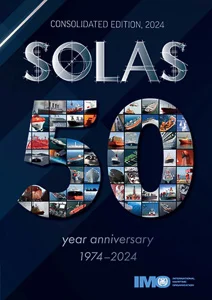
SOLAS Consolidated Edition 2024 — available from Dandy Booksellers Australia
Most people in the maritime industry have heard of SOLAS. It sits behind almost everything to do with how commercial ships are built, equipped, and operated. But knowing it exists and actually working from the current text are two different things. The 2024 consolidated edition pulls together years of accumulated amendments into a single reference. Some of those amendments, particularly around mooring operations, apply to ships already in service. If your onboard documentation hasn’t caught up, a port state control inspector will find that out before you do.
This guide covers where SOLAS came from, what the 2024 edition contains, what actually changed, and who should have a copy on board or in the office.
Where SOLAS Came From
The first SOLAS treaty was adopted in 1914, two years after the Titanic sank with the loss of more than 1,500 lives.[ 1 ] That disaster made one thing painfully obvious: there was no consistent international standard for maritime safety. Ships carried too few lifeboats. There was no requirement for a 24 hour radio watch. Evacuation procedures varied from one vessel to the next. The international response was a binding treaty.
Four more versions followed: in 1929, 1948, 1960, and 1974. The 1914 treaty never actually entered into force because of World War I. The current version was adopted in 1974 and entered into force on 25 May 1980.[ 1 ] Rather than rewriting the entire Convention each time something needs updating, the IMO uses a system of amendments. Those amendments build up over time. A consolidated edition gathers them all into one document so you can work from a single current text instead of tracking changes across decades of separate amendment circulars.
The 2024 edition also marks the 50th anniversary of the 1974 Convention.[ 2 ]
What the 2024 Edition Contains
This edition consolidates the Convention text, its 1988 Protocol, and all amendments that entered into force on or before 1 July 2024.[ 2 ] It includes the Unified Interpretations of SOLAS regulations approved by the Maritime Safety Committee. Those interpretations matter in practice because they clarify how provisions that could be read more than one way should actually be applied.
The publication covers every chapter of the Convention: ship construction and stability, fire protection and detection, life saving appliances, radio communications (including the GMDSS), safety of navigation, carriage of cargoes, and carriage of dangerous goods.
Chapter VII is the one that makes the IMDG Code mandatory for ships carrying dangerous goods in packaged form. SOLAS and the IMDG Code work as a pair. If dangerous goods compliance is part of your day to day responsibilities, you need both. For a closer look at how the IMDG Code works in practice, see our guide to the IMDG Code 2024 Edition.
What Changed in the 2024 Edition
Four areas were updated. Here is what each one means for operations.
Mooring Operations
The amended Regulation II-1/3-8 introduces new requirements for the selection, arrangement, inspection, maintenance, and replacement of mooring equipment and lines.[ 3 ] The regulation applies to passenger ships regardless of size and cargo ships of 500 GT and above.[ 4 ]
There are two tiers of requirements. Design requirements for mooring arrangements (based on IMO Guidelines MSC.1/Circ.1619) apply to new cargo and passenger ships of 3,000 GT and above with building contracts on or after 1 January 2024. Ships below 3,000 GT are encouraged to follow the guidelines as far as reasonably practicable.[ 4 ]
The inspection and maintenance requirements are different. They apply to all ships from 1 January 2024 regardless of build date. This is retroactive. Ships must keep documentation of their mooring arrangements, and mooring equipment including lines must be inspected and maintained in a condition suitable for their intended purpose. Port state control inspectors check mooring records. If your documentation is not current, fix it before your next inspection.[ 4 ]
GMDSS Modernisation
The Global Maritime Distress and Safety System requirements have been overhauled. For years, Inmarsat was the only approved GMDSS satellite service provider. In 2020, the IMO recognised Iridium as an additional provider.[ 5 ] The 2024 amendments move to technology neutral standards, replacing specific references to “INMARSAT” with the term “Recognised Mobile Satellite Service” (RMSS). This opens the door for multiple providers going forward.
Communication equipment requirements have moved from Chapter III (Life Saving Appliances) to Chapter IV (Radiocommunications), which is where they logically belong. The amendments also remove requirements for obsolete systems like NBDP (narrowband direct printing telegraphy), which is no longer mandatory.[ 5 ]
For ships certified to operate in sea area A3, the Cargo Ship Safety Radio Certificate must now indicate which recognised mobile satellite service the ship uses (Inmarsat or Iridium). Ships fitted with Iridium get global coverage for A3 purposes.[ 5 ]
Watertight Integrity
Amendments to Chapter II-1 bring the watertight integrity requirements in parts B-2 to B-4 into line with the probabilistic damage stability approach in parts B and B-1.[ 3 ] That approach was introduced in 2009 and assesses a ship’s probability of surviving flooding based on the location and extent of damage. It gives a more realistic picture of survivability than older deterministic methods, and it allows more flexibility in where watertight bulkheads are placed.
The amendments also address assumptions about progressive flooding, valves in the collision bulkhead, and watertight doors. They apply to new ships constructed on or after 1 January 2024. Existing vessels are not affected.[ 3 ]
Life Saving Appliances and IGF Code
The 2024 edition incorporates amendments to the LSA Code (Life Saving Appliances) and the IGF Code (International Code of Safety for Ships using Gases or other Low Flashpoint Fuels). The IGF Code applies to ships running on LNG and similar fuels. As more vessels adopt alternative fuels, keeping that code current matters for anyone involved in fleet planning or newbuild specification.
Who Needs a Copy of SOLAS
SOLAS applies to commercial ships on international voyages. As a general rule, that means cargo ships, tankers, passenger ships, and other commercial vessels of 500 GT and above trading internationally. Fishing vessels, pleasure craft, and ships on purely domestic voyages are generally outside its scope.[ 1 ]
The people who most commonly need a copy include ship masters and officers, fleet managers, safety officers, designated persons ashore (DPAs), port state control inspectors, flag state surveyors, maritime lawyers, and naval architects working on new builds or major conversions.
If your company operates internationally trading vessels, you need the current edition. SOLAS amendments carry legal force from the date they enter into force, whether or not you’ve updated your copy. Working from an old edition does not protect you from non-compliance.
SOLAS and Its Mandatory Codes
The Convention references and makes mandatory a number of technical codes. The main ones are the IMDG Code for dangerous goods (Chapter VII), the ISM Code for safety management (Chapter IX), the ISPS Code for security (Chapter XI-2), the LSA Code, and the FSS Code. A port state control surveyor checking your SOLAS compliance is checking the Convention and all those mandatory codes together. The consolidated edition gives you everything in one place.
For a practical overview of how dangerous goods regulations work across sea, air, and road transport in Australia, see our guide to Dangerous Goods Compliance in Australia.
How Often SOLAS Gets Updated
The IMO uses a “tacit acceptance” procedure for SOLAS amendments. Once adopted by the Maritime Safety Committee, amendments enter into force on a set date unless enough member states formally object. In practice, batches of amendments tend to enter into force every few years. The most recent set, adopted at MSC sessions 106, 107, and 108, entered into force on 1 January 2026.[ 6 ] That batch includes new requirements for lifting appliances, updates to fire protection, and an extension of the Polar Code to smaller vessels.
A consolidated edition is the most practical way to keep up with these changes rather than tracking individual amendment circulars and resolutions.
Important: Regulations change frequently. Always verify requirements against the current official edition of the relevant publication. This article is intended as a general guide only and does not constitute legal or compliance advice.
Frequently Asked Questions
What is the SOLAS Consolidated Edition 2024?
It is the official IMO publication containing the complete text of the SOLAS Convention, its 1988 Protocol, and all amendments in force on or before 1 July 2024. It also includes the Unified Interpretations of SOLAS regulations adopted by the Maritime Safety Committee.
Is the SOLAS Consolidated Edition 2024 mandatory?
SOLAS itself is a mandatory international treaty for commercial ships on international voyages. The consolidated edition is the authoritative published reference for those requirements. Having the current edition is the most reliable way to make sure your team is working from the correct text.
What are the most significant changes in the 2024 edition?
The key changes cover mooring operations (including retroactive maintenance requirements for all ships), GMDSS modernisation to accommodate multiple satellite providers, updated watertight integrity requirements for new builds, and amendments to the LSA and IGF Codes. The mooring maintenance requirements are the most immediately relevant for ships already in service.
Do the 2024 SOLAS amendments apply to existing ships?
Some do and some don’t. The mooring inspection and maintenance requirements are retroactive and apply to all passenger ships and cargo ships of 500 GT and above from 1 January 2024. The mooring design requirements apply only to new ships of 3,000 GT and above built on or after that date. The watertight integrity amendments apply only to new construction.
Where can I buy the SOLAS Consolidated Edition 2024 in Australia?
Dandy Booksellers Australia is an authorised IMO distributor. We supply the SOLAS Consolidated Edition 2024 with free delivery to Australian and New Zealand addresses.
When is the next SOLAS update due?
The most recent batch of amendments, adopted at MSC sessions 106, 107, and 108, entered into force on 1 January 2026. These include new requirements for lifting appliances, fire protection updates, and the extension of the Polar Code to smaller vessels.
References
[ 1 ] IMO, International Convention for the Safety of Life at Sea (SOLAS), 1974 — https://www.imo.org/en/About/Conventions/Pages/International-Convention-for-the-Safety-of-Life-at-Sea-(SOLAS),-1974.aspx
[ 2 ] IMO e-Publications, SOLAS Consolidated Edition 2024 (ISBN 978-92-801-1793-6) — https://imo-epublications.org/content/books/9789280117936
[ 3 ] DNV, What is new with SOLAS 2024 — https://www.dnv.com/news/2022/what-s-new-with-solas-2024--227502/
[ 4 ] Bureau Veritas, Safe Mooring: Entry into force on 1 January 2024 of amended SOLAS Regulation II-1/3-8 — https://marine-offshore.bureauveritas.com/newsroom/safe-mooring-entry-force-1-january-2024-amended-solas-regulation-ii-13-8
[ 5 ] Bureau Veritas, Modernization of GMDSS: Entry into force on 1 January 2024 of amended SOLAS Chapter IV — https://marine-offshore.bureauveritas.com/newsroom/modernization-gmdss-entry-force-1-january-2024-amended-solas-chapter-iv
[ 6 ] IMO, Raft of shipping rules in force from 1 January 2026 — https://www.imo.org/en/mediacentre/pressbriefings/pages/raft-of-shipping-rules-in-force-from-1-january-2026.aspx
Related products

Free Delivery

Free delivery to all Australian and New Zealand mailing addresses.
Discounted E-books
For faster turnaround.
Download link via email within a couple of hours.
Information
 Home
HomeNew Products

Email us at sales@dandybooksellers.com.au
Australia
Dandy Booksellers
58 Allambi Avenue
Broadbeach Waters
4218 Queensland
United Kingdom
Dandy Booksellers Ltd
15 Hoopers Yard
Kimberley Road
London NW6 7EJ
Company registration number: 4846829



All prices in Australian Dollars (AUD)
