




IATA DGR 67th Edition 2026: What It Is, What Changed, and Who Needs It
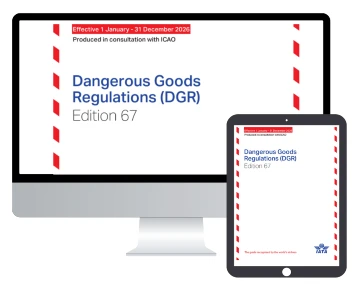
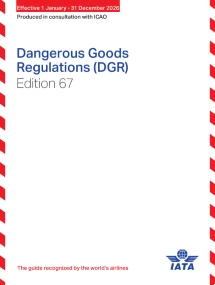
What is the IATA Dangerous Goods Regulations (DGR)? The IATA Dangerous Goods Regulations (DGR) is the industry operational standard used by airlines worldwide for the safe transport of hazardous materials by air. Published annually by IATA, the 67th Edition 2026 covers classification, packaging, documentation, and handling of dangerous goods on passenger and cargo aircraft.
If you work in freight forwarding, logistics, or any industry that ships goods by air, the IATA Dangerous Goods Regulations — commonly known as the DGR — is the book your business runs on. A new edition is published every year, and staying current is not optional. Here is what you need to know about the 67th Edition, effective 1 January 2026.
What Is the IATA DGR?
The IATA Dangerous Goods Regulations is the industry operational standard for the safe transport of hazardous materials by air, recognised by airlines worldwide as the definitive reference for classifying, packing, marking, labelling, and documenting dangerous goods on passenger and cargo aircraft.[ 1 ]
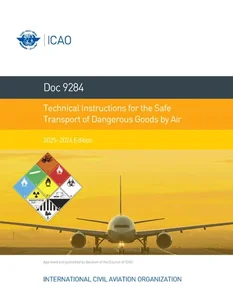
The regulations sit alongside and are consistent with the ICAO Technical Instructions for the Safe Transport of Dangerous Goods by Air, which are the legally binding international rules.[ 2 ] The DGR translates those instructions into practical, day-to-day guidance that freight forwarders, shippers, ground handlers, and airline staff can use.
Who Needs the IATA DGR?
In short: anyone whose work involves shipping dangerous goods by air. This includes shippers preparing documentation, freight forwarders accepting and processing DG consignments, airline cargo staff, ground handlers, dangerous goods trainers, and compliance officers. In practice many operators require staff to use the current DGR to ensure compliance with the ICAO Technical Instructions.
It is also a core training resource. Most IATA-accredited DG training courses require participants to bring or purchase their own copy of the DGR, and certification is tied to the edition in use at the time of training.[ 1 ]
Why Does the IATA DGR Update Every Year?
The transport of dangerous goods is an area of constant change. New substances are classified, existing entries are revised, packaging requirements are tightened, and global incidents prompt regulatory responses. IATA updates the DGR annually to keep pace with those changes and to align with amendments made by ICAO.
Some of the areas that change most frequently include lithium battery regulations, packing instructions, quantity limits, and the addition or amendment of special provisions. Using an out-of-date edition is not just a compliance risk — it can mean rejected shipments, fines, or in serious cases, safety incidents.
IATA DGR 67th Edition 2026 — Key Changes
The 67th Edition of the IATA DGR came into effect on 1 January 2026. It incorporates amendments from the ICAO Technical Instructions 2025–2026 and updates from the IATA Dangerous Goods Board. Here are the changes most likely to affect day-to-day operations.[ 3 ]
Lithium battery state-of-charge limits — extended to UN 3481 from January 2026
The 67th Edition extended the mandatory =30% state-of-charge (SoC) limit to both main categories of lithium ion battery shipment on cargo aircraft. UN 3480 (batteries shipped alone) has carried this mandatory cap for a number of years. From 1 January 2026, the mandatory cap also applies to UN 3481 (batteries packed with or contained in equipment) where the cells or batteries have a Watt-hour rating greater than 2.7 Wh. This is a significant change: what was a recommendation in the 2025 DGR (66th Edition) became a mandatory requirement from 1 January 2026. In limited cases, approval may be sought to exceed this threshold, but shippers can no longer treat the =30% SoC limit for UN 3481 as optional guidance.[ 3 ]
See also: Shipping Lithium Batteries by Air and Sea: What the Regulations Actually Require
Passenger and cabin provisions updated
Section 2.3 includes updated guidance for passengers and crew travelling with power banks and spare lithium batteries. Spare batteries must not be placed in checked baggage — this long-standing requirement remains firm.[ 4 ] Individual airlines may impose their own restrictions on the use of power banks and portable charging devices during flight, including limitations on in-seat USB charging of spare batteries — always check your carrier's policy before travelling. Watt-hour limits for carry-on batteries also apply: passengers may carry no more than two lithium ion batteries (including power banks) exceeding 100 Wh but not exceeding 160 Wh in the cabin, subject to prior airline approval.[ 4 ]
Hybrid vehicle entries updated
The List of Dangerous Goods includes updated advisory proper shipping names for hybrid vehicles under UN 3166 — specifically 'Vehicle, flammable gas powered, hybrid' and 'Vehicle, flammable liquid powered, hybrid'. These entries help operators and ground handlers better assess the risks associated with hybrid-powered vehicles being transported as cargo.
Other notable changes
Other notable changes include a new Appendix H previewing potential 2027 updates, clarifications to the Shipper's Declaration requirements, updated acceptance checklist guidance, and updated provisions clarifying the treatment of small data loggers and cargo tracking devices containing lithium batteries. State variations have been updated to include Thailand, with significant revisions for France and the UK.[ 3 ]
The 67th Edition is available in standard hardcover, spiral-bound (popular for desk reference), and digital format. IATA also publishes an official Significant Changes summary at iata.org, which is worth bookmarking if your team needs to brief staff on what has changed.
How to Stay Compliant with Dangerous Goods Regulations in Australia
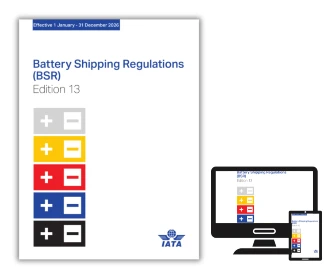
Replace your copy at the start of each calendar year. Many organisations purchase copies for each member of staff who handles dangerous goods documentation or acceptance. The IATA DGR 67th Edition 2026 and the IATA Battery Shipping Regulations (BSR) 13th Edition 2026 are both available from Dandy Booksellers Australia in print and digital formats. If your team runs DG training, ensure the edition used in training matches the one effective at the time of the course.
For Australian operators, CASA requires compliance with ICAO Technical Instructions,[ 5 ] and in practice this means the DGR is the working reference most commonly used by the industry. Keeping a current copy on hand is one of the simplest ways to demonstrate compliance during an audit.
See also: Dangerous Goods Compliance in Australia: Road, Air and Sea Requirements
Important: Regulations change frequently. Always verify requirements against the current official edition of the relevant publication. This article is intended as a general guide only and does not constitute legal or compliance advice.
Frequently Asked Questions
What is the current edition of the IATA DGR?
The current edition is the 67th Edition, which came into effect on 1 January 2026. It is updated annually by IATA and replaces the previous edition at the start of each calendar year. Using an outdated edition is a compliance risk and can result in rejected shipments or audit findings.
Who needs the IATA Dangerous Goods Regulations?
Anyone involved in shipping hazardous materials by air — including shippers, freight forwarders, ground handlers, airline cargo staff, and compliance officers. Most IATA-accredited dangerous goods training courses also require participants to hold and use the current edition.
How often does the IATA DGR update?
The IATA DGR is updated annually. A new edition is published each year and comes into effect on 1 January. Staying current is essential: regulations change every year, and using an out-of-date edition can lead to non-compliant shipments.
What changed in the IATA DGR 67th Edition 2026?
Key changes include the extension of the mandatory =30% state-of-charge limit to UN 3481 batteries packed with equipment, updated passenger provisions for power banks and spare batteries, updated proper shipping names for hybrid vehicles under UN 3166, a new Appendix H previewing potential 2027 updates, and updated state variations for France, the UK, and Thailand.
Where can I buy the IATA DGR in Australia?
The IATA DGR 67th Edition 2026 is available from Dandy Booksellers Australia in print (hardcover and spiral-bound) and digital (eBook) formats, with fast delivery across Australia.
Is the IATA DGR the same as the ICAO Technical Instructions?
Not exactly. The ICAO Technical Instructions are the internationally legally binding rules for dangerous goods by air. The IATA DGR is consistent with those instructions and translates them into practical operational guidance used by the airline industry globally. For most freight and logistics operations, the DGR is the primary working reference.
References
[ 1 ] IATA Dangerous Goods — Official Program Page — https://www.iata.org/en/programs/cargo/dgr/
[ 2 ] ICAO Technical Instructions for the Safe Transport of Dangerous Goods by Air — https://www.icao.int/safety/dangerousgoods/Pages/technical-instructions.aspx
[ 3 ] IATA DGR 67th Edition — Significant Changes and Amendments 2026 — https://www.iata.org/contentassets/90f8038b0eea42069554b2f4530f49ea/dgr-67-en-significant-changes.pdf
[ 4 ] IATA — Passenger Guidance: Lithium Batteries — https://www.iata.org/contentassets/6fea26dd84d24b26a7a1fd5788561d6e/passengers_travelling_with_lithium_batteries.pdf
[ 5 ] CASA — Dangerous Goods (Australia) — https://www.casa.gov.au/dangerous-goods
Related products
Free Delivery

Free delivery to all Australian and New Zealand mailing addresses.
Discounted E-books
For faster turnaround.
Download link via email within a couple of hours.
Information
 Home
HomeNew Products

Email us at sales@dandybooksellers.com.au
Australia
Dandy Booksellers
58 Allambi Avenue
Broadbeach Waters
4218 Queensland
United Kingdom
Dandy Booksellers Ltd
15 Hoopers Yard
Kimberley Road
London NW6 7EJ
Company registration number: 4846829



All prices in Australian Dollars (AUD)
