




UN Numbers Explained: How to Read a UN Number and Proper Shipping Name
What is a UN number? A UN number is a four-digit code assigned by the United Nations Sub-Committee of Experts on the Transport of Dangerous Goods to identify a hazardous substance or article in transport. Each number is tied to a set proper shipping name, for example UN 3480, Lithium ion batteries. The same number is used for air, sea, road and rail.
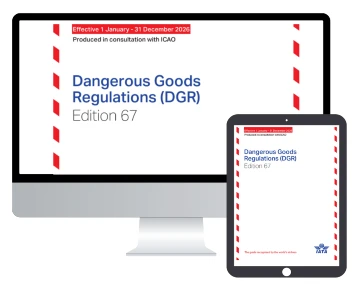
IATA Dangerous Goods Regulations 67th Edition 2026 — available from Dandy Booksellers Australia
A UN number looks like a minor detail on a transport document. It is actually the decision that drives everything else: how the goods must be packed, what labels go on the outside, what paperwork the airline or shipping line needs, how much can go in one package, and whether the cargo can travel on a passenger aircraft at all. Shippers who guess at it tend to find out the hard way.
What a UN number actually is
A UN number is a four-digit code that identifies a dangerous substance or article in transport. The numbers are assigned by the United Nations Sub-Committee of Experts on the Transport of Dangerous Goods and published in the Recommendations on the Transport of Dangerous Goods: Model Regulations, known in the trade as the Orange Book. The current version is the 24th revised edition, published in September 2025.[ 1 ]
There are several thousand entries, and new numbers are still being assigned as substances and articles are added. They are not organised by hazard, so you cannot read anything into a number by looking at it. UN 1203 is petrol. UN 1950 is aerosols. UN 3480 is lithium ion batteries shipped on their own. The number is an index entry, not a code you can decipher.
Every mode of transport uses the same numbers, and that is the point of the system. The air rules, the sea rules and the Australian road and rail rules all trace back to the same UN framework, so a substance keeps its identity from the factory floor to the aircraft hold.[ 2 ]
Why the proper shipping name matters as much as the number
A UN number never travels alone. Each one is paired with a proper shipping name, which is the official description of the goods. UN 3480 is Lithium ion batteries. UN 1263 is Paint. The pair has to match. Putting a correct UN number next to a description you have written yourself, or next to a supplier’s trade name, is still a documentation error.
Three things catch people out.
The name in the book is the name you use
In the List of Dangerous Goods, the proper shipping name appears in Roman type. Words shown in italics, along with punctuation and some lower-case text, are there to help you find the right entry and do not form part of the name itself.[ 10 ]
N.O.S. entries need a technical name
Where an entry ends in “n.o.s.”, meaning not otherwise specified, you generally have to add the technical name of the hazardous constituent in brackets after the shipping name. “Flammable liquid, n.o.s. (Toluene)” is a complete description. “Flammable liquid, n.o.s.” on its own usually is not.[ 10 ]
Some entries look almost identical
UN 3480 covers lithium ion batteries shipped by themselves. UN 3481 covers the same chemistry when the batteries are contained in equipment or packed with it. Same product, different presentation, different UN number, different packing instruction and different paperwork. Our guide to shipping lithium batteries works through that distinction in detail.
Where the answer lives: Section 4.2 of the IATA DGR
For air freight, the master table is Section 4.2 of the IATA Dangerous Goods Regulations, the List of Dangerous Goods. It is arranged alphabetically by proper shipping name, and each row runs across a set of columns giving the UN or ID number, class or division, subsidiary hazard, packing group, labels, packing instructions, the maximum quantity permitted per package on passenger and cargo aircraft, and any special provisions that apply.[ 3 ]
If you have the number but not the name, Section 4.3 lists the same entries in numerical order, so you can work backwards from the UN number to the proper shipping name.[ 3 ]
The DGR also carries ID numbers, which look similar but are not UN numbers. ID 8000, Consumer commodity, is the one most people meet. These are IATA air transport entries and have no equivalent in the sea or road rules.
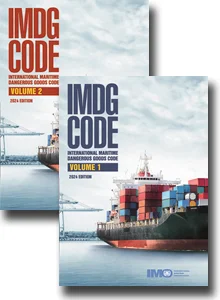
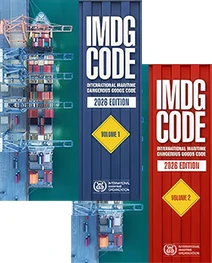
For sea freight the equivalent table is the Dangerous Goods List in Part 3 of the IMDG Code, which is mandatory under Chapter VII of the SOLAS Convention.[ 4 ] The UN numbers are the same. The packing instructions, segregation rules and stowage requirements are not, which is why forwarders who ship both ways keep both books on the desk. Our IMDG Code 2024 guide covers what is in that publication.
What happens when the classification is guessed
Picture a small manufacturer sending a pallet of cleaning product to Auckland. The safety data sheet says corrosive. Someone searches online, finds a UN number that looks close enough, and books the freight.
At the airline’s acceptance check the declaration does not match the entry in Section 4.2. The packing instruction quoted belongs to a different packing group, so the drums on the pallet are not approved for what is actually inside them. The shipment is refused. The pallet sits in a bond store while a fresh declaration is prepared and repacking is arranged, the customer’s delivery date is gone, and the forwarder now has a rejected consignment on file.
That is the good outcome. The bad one is that nobody catches it. Undeclared and misdeclared dangerous goods are a recognised safety problem in air cargo, and lithium batteries are the clearest example: batteries shipped as something harmless have been linked to fires in cargo holds.[ 5 ][ 7 ] Firefighting capability in a hold is limited, and the crew’s options depend on knowing what is down there.
There is a legal edge to this as well. In Australia the carriage of dangerous goods by air is regulated under Part 92 of the Civil Aviation Safety Regulations, and CASA runs a reporting channel for dangerous goods events, which covers undeclared and misdeclared consignments.[ 6 ][ 11 ] At sea, AMSA gives effect to the IMDG Code through Marine Order 41 and inspects vessels under port State control, with detention powers under the Navigation Act 2012.[ 8 ]
Who is responsible for getting it right
The shipper is. Not the freight forwarder, not the airline, not the person who wrote the safety data sheet. Under both the air and the sea regimes the consignor is responsible for classifying, packing, marking, labelling and documenting the goods correctly. A forwarder can check your paperwork and a good one will, but that check is a second pair of eyes. It is not a transfer of liability.
This is also why trained staff matter. Both the DGR and the IMDG Code set out training requirements, and the person who signs the declaration is stating that the description is complete and accurate.
A working method that keeps you out of trouble
Start with the safety data sheet. Section 14 of an SDS gives the transport information, including the UN number and proper shipping name the manufacturer has assigned. Treat it as a starting point rather than the final word, because transport sections are sometimes out of date or written for another country.
Then find the entry in the book. Look the name up in Section 4.2 of the DGR, or the number in Section 4.3, and read the whole row rather than the first two columns. Check the special provisions codes, because they change the answer more often than people expect, and confirm the packing instruction matches the packaging you actually have in the warehouse.
Check Section 2.8 as well. State and operator variations sit there, and an entry that is fine under the general rules can still be refused by a particular airline or country. Finally, write the description in the order the regulations require and word it exactly as the book has it.
If any step leaves you unsure, stop and ask. A phone call to your forwarder costs nothing. A misdeclared consignment costs a great deal more.
Which book you need
None of this works from memory or from a search engine. The List of Dangerous Goods is revised every year, and the current air edition is the IATA DGR 67th Edition, which applies from 1 January 2026 to 31 December 2026.[ 9 ] If you ship by air, that is the book that needs to be on the desk. If you ship by sea as well, the IMDG Code 2024 sits alongside it.
→ Buy the IATA DGR 67th Edition 2026 from Dandy Booksellers
→ Buy the IMDG Code 2024 (two-volume set) from Dandy Booksellers
→ Buy the Sea and Air Pack (IMDG Code 2024 + IATA DGR 67th Edition)
Important: Regulations change frequently. Always verify requirements against the current official edition of the relevant publication. This article is intended as a general guide only and does not constitute legal or compliance advice.
Frequently Asked Questions
What is a UN number?
A UN number is a four-digit code that identifies a dangerous substance or article in transport. It is assigned by the United Nations Sub-Committee of Experts on the Transport of Dangerous Goods and always used together with a proper shipping name, for example UN 3480, Lithium ion batteries.
Who assigns UN numbers?
The United Nations Sub-Committee of Experts on the Transport of Dangerous Goods assigns them and publishes them in the UN Model Regulations, often called the Orange Book. The air, sea, road and rail regulations then adopt those numbers.
What is the difference between a UN number and a proper shipping name?
The UN number is the numeric identifier. The proper shipping name is the official written description that goes with it. Both must appear on the package marking and on the dangerous goods declaration, and they must match the entry in the regulations.
Is a UN number the same for air, sea and road?
Yes. The number itself is consistent across modes because they all draw on the same UN Model Regulations. What changes between modes is the packing, labelling, quantity limits, stowage and segregation rules that attach to that number.
Where do I find the list of UN numbers?
For air, Section 4.2 of the IATA Dangerous Goods Regulations lists entries alphabetically by proper shipping name and Section 4.3 lists them numerically by UN number. For sea, the Dangerous Goods List sits in Part 3 of the IMDG Code.
Where can I buy the IATA DGR in Australia?
The IATA DGR 67th Edition 2026 is available from Dandy Booksellers Australia in regular bound, spiral bound and digital formats, with free shipping to Australia and New Zealand on print titles. The IMDG Code 2024 and the Sea and Air Pack are also available.
References
[ 1 ] UNECE — UN Model Regulations Rev. 24 (2025) — https://unece.org/transport/dangerous-goods/un-model-regulations-rev-24
[ 2 ] UNECE — Recommendations on the Transport of Dangerous Goods: Model Regulations — https://unece.org/transport/publications/recommendations-transport-dangerous-goods-model-regulations
[ 3 ] IATA — Dangerous Goods Regulations (DGR) — https://www.iata.org/en/programs/cargo/dgr/
[ 4 ] IMO — Dangerous goods (IMDG Code) — https://www.imo.org/en/OurWork/Safety/Pages/DangerousGoods-default.aspx
[ 5 ] CASA — Lithium batteries — https://www.casa.gov.au/dangerous-goods/lithium-batteries
[ 6 ] CASA — Part 92 of CASR, Consignment and carriage of dangerous goods by air — https://www.casa.gov.au/rules-parts/part-92-casr
[ 7 ] CASA — Dangerous goods and air freight — https://www.casa.gov.au/operations-safety-and-travel/safety-advice/dangerous-goods-and-air-freight
[ 8 ] AMSA — Cargo regulations (Marine Order 41 and the IMDG Code) — https://www.amsa.gov.au/vessels-operators/cargoes-and-dangerous-goods/cargo-regulations
[ 9 ] IATA — Significant Changes and Amendments in the 67th Edition (2026) — https://www.iata.org/contentassets/90f8038b0eea42069554b2f4530f49ea/dgr-67-en-significant-changes.pdf
[ 10 ] UNECE — Model Regulations, Part 3: Dangerous Goods List and proper shipping names — https://unece.org/DAM/trans/danger/publi/unrec/English/part3.pdf
[ 11 ] CASA — Report a dangerous goods event — https://www.casa.gov.au/about-us/contact-us/report-dangerous-goods-event
Free Delivery

Free delivery to all Australian and New Zealand mailing addresses.
Discounted E-books
For faster turnaround.
Download link via email within a couple of hours.
Information
 Home
HomeNew Products

Email us at sales@dandybooksellers.com.au
Australia
Dandy Booksellers
58 Allambi Avenue
Broadbeach Waters
4218 Queensland
United Kingdom
Dandy Booksellers Ltd
15 Hoopers Yard
Kimberley Road
London NW6 7EJ
Company registration number: 4846829



All prices in Australian Dollars (AUD)
