




Power Bank Rules 2026: What the ICAO Addendum Means for Operators and Shippers
What changed for power banks on 27 March 2026? ICAO issued Addendum No. 1 to the 2025 to 2026 Technical Instructions, effective the same day. It separates power banks from spare batteries, limits each person to two power banks, and prohibits recharging a power bank on board. The changes carry into the IATA DGR 68th Edition from 1 January 2027.
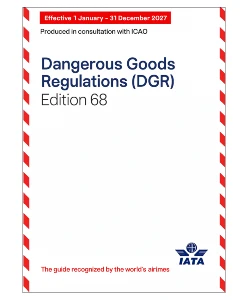
IATA Dangerous Goods Regulations 68th Edition 2027 — available to pre-order from Dandy Booksellers Australia
Power banks have been treated as spare batteries for years. On 27 March 2026 that stopped. ICAO published an addendum to the Technical Instructions with immediate effect, and for the first time power banks have their own set of rules, their own definition, and their own limits. If you run an airline, handle passengers, or write the dangerous goods sections of an operations manual, this one lands on your desk rather than someone else’s.
What the addendum actually changed
ICAO’s Council approved the change and it took effect on the day it was announced.[ 1 ] Addendum No. 1 amends the 2025 to 2026 Edition of the Technical Instructions (Doc 9284) and applies from 27 March 2026.[ 2 ][ 4 ] IATA followed on 31 March with a guidance document for operators.[ 3 ]
Three changes matter most:
- Definition. Power banks are separated from spare batteries and given their own definition.
- Quantity. No more than two power banks per person, for passengers and for crew carrying them for personal use.
- Recharging. A power bank must not be recharged on board the aircraft.
The guidance is written to sit alongside the 67th Edition of the IATA DGR and stops being effective after 31 December 2026. From 1 January 2027 the rules live in the 68th Edition itself.[ 3 ]
Power banks are no longer “spare batteries”
The old approach treated a power bank as just another spare battery. IATA’s reasoning for splitting them is worth understanding, because it explains why the rules are tighter rather than looser. A spare battery is designed to fit a specific device, which makes it a poor target for counterfeiting. A power bank is a universal external supply that charges anything with a cable, so the market is flooded with cheap product from manufacturers who never tested to UN 38.3.[ 3 ][ 8 ]
IATA also singles out wireless power banks, which charge by induction with no physical connection to the device. They are new, easy to counterfeit, and passengers have reported them going into thermal runaway.
The definitions now read:
- Power bank: an easily carried universal external power source capable of powering multiple devices, usually made up of multiple cells.
- Spare battery: single cell or multi-cell batteries designed to be inserted into or directly affixed to a specific device.
For the wider picture on battery classification and UN numbers, see our guide to shipping lithium batteries by air and sea.
What passengers and crew can now carry
For power banks carried for personal use, the addendum sets out five requirements. Two are new.[ 2 ][ 3 ] IATA maintains a parallel guidance document aimed at passengers and crew carrying these devices for personal use.[ 5 ]
- carry-on baggage only, never checked. Existing requirement.
- must not be recharged while on board. New requirement.
- should not be used to recharge a portable electronic device while on board. New recommendation.
- no more than two power banks per person. New requirement.
- must be individually protected against short circuit when not in use. Existing requirement.
The distinction most coverage is getting wrong
Read those two middle points again. Recharging the power bank itself is prohibited. Using the power bank to charge your phone is a recommendation, not a prohibition. The addendum uses “must not” for the first and “should not” for the second, and in regulatory drafting that difference is deliberate.
It matters operationally. Cabin crew enforcing a blanket ban on all power bank use will be applying something stricter than the rule requires, and passengers who have read the news will arrive expecting one thing while your crew apply another. Individual airlines are free to impose a stricter policy, but it needs to be stated as carrier policy rather than as an international requirement.
If you are flying rather than writing the policy, check your airline’s conditions of carriage before you travel. Theirs is the rule that gets applied at the gate, and several carriers have gone further than the addendum requires.
The 100 to 160 Wh question
This one needs care. The addendum text allows a battery over 100 Wh but not over 160 Wh with operator approval. IATA’s own passenger table, however, marks power banks in that range as forbidden, and IATA states plainly that the 100 to 160 Wh provision for power banks will not be carried into the 68th Edition of the DGR.[ 3 ]
That leaves a gap between the letter of the addendum and where IATA is steering. To be clear that this is our recommendation rather than the rule itself: treat power banks above 100 Wh as not going on the aircraft. The approval route closes in January, and IATA’s own table already marks the band forbidden, so building a process around a provision with five months left in it is effort you will spend twice. Anything above 160 Wh has to move as cargo under the full dangerous goods rules.
The per-person limits sit alongside each other like this:
| Item | Limit per person | Checked baggage | Operator may approve more |
|---|---|---|---|
| Portable electronic devices | 15 | Conditions apply | Yes |
| Spare batteries (any type) | 20 | Not permitted | Yes |
| Power banks | 2 | Not permitted | No |
The two power bank limit is the one with no flexibility in it.
Power banks used by crew on duty
This is the part operators most often miss, and it sits under “Dangerous Goods of the Operator” rather than under passenger provisions. The addendum makes specific provision for power banks that an operator provides, or otherwise approves, for crew to use in flight while performing their duties. Electronic flight bags, personal entertainment devices and credit card readers are the examples given.[ 2 ][ 3 ]
Three conditions attach:
- Batteries in the device, spare batteries and power banks must not exceed 100 Wh. There is no operator approval route above that for operational use.
- Batteries must meet each test in the UN Manual of Tests and Criteria, Part III, sub-section 38.3, and lithium metal batteries must not exceed 2 g lithium content.
- The conditions for carriage and use must be written into the operations manual, the flight attendant manual, or whichever manual the relevant crew actually work from.
If your crew do not use operator-provided power banks for their duties, IATA expects little more than a line making clear that the passenger provisions apply to personal use only, not to operational tasks. If they do, the safety risk management work is more substantial: sourcing from suppliers who can evidence UN 38.3 compliance, deciding whether to publish a list of approved models, setting inspection routines for damage and deterioration, deciding how spares are stored when not in use, and revisiting thermal runaway response procedures.
Does it apply in Australia yet?
Not automatically, and this is the point operators need to handle carefully. IATA is direct about it: an ICAO addendum interacts with State sovereignty, and enforceability depends on how each State adopts the change. For some it is immediate, some need a short administrative period, and some need public notification and legislative amendment.[ 3 ]
In Australia the carriage of dangerous goods by air runs through Part 92 of the Civil Aviation Safety Regulations, which gives effect to the ICAO Technical Instructions.[ 7 ][ 10 ] Rather than assume a position, check the current status with CASA directly, whose lithium battery guidance is the first place an Australian operator should look, and confirm it for every destination State you fly to.[ 9 ] Our guide to dangerous goods compliance in Australia sets out how the Australian framework fits together.
IATA’s advice is to engage the national aviation authority early rather than wait, and to consider whether the safety case justifies acting ahead of a legal requirement. Interim measures such as clearer passenger messaging or additional screening questions are reasonable, provided they are proportionate, documented, and not presented as something they are not.
What to do before 31 December
The guidance document expires at the end of the year, so there is a natural deadline for getting the permanent version in place.
- Work out whether crew use power banks operationally. That single answer decides how much work follows.
- Update the operations manual, flight attendant manual, dangerous goods procedures and training material.
- Brief passenger-facing staff before you brief passengers. Inconsistent application at check-in does more damage than a slow rollout.
- Align codeshare partners, ground handlers and contracted passenger handling providers. A rule applied at one end of a route and not the other creates arguments at the gate.
- Get the 68th Edition on the desk before January, because from 1 January 2027 it is the reference, not the addendum.
What is inside the DGR
If you are ordering the DGR for the first time, or justifying the cost to someone who has not used one, it runs to ten sections:
- 1. Applicability: shipper and operator responsibilities, training, security, incident reporting.
- 2. Limitations: forbidden and hidden goods, quantity limits, transport by post, transport by passengers and crew. The power bank provisions live here.
- 3. Classification: explosives, gases, flammable, toxic, oxidising, radioactive, corrosive and multiple hazard material.
- 4. Identification: the List of Dangerous Goods, UN numbers and proper shipping names.
- 5. Packing: packing instructions by hazard class.
- 6. Packaging Specifications and Performance Tests: inner packagings, UN specification packagings, construction and testing, limited quantity.
- 7. Marking and Labelling: what goes on the outside of the package.
- 8. Documentation: shipper’s declaration and air waybill.
- 9. Handling: storage, loading, inspection, information provision, reporting, training, document retention.
- 10. Radioactive Material: transport, limitations, classification, identification, packing, testing, labelling, documentation and handling of radioactive material.
Which edition you need
The addendum and IATA’s guidance document are a stopgap. They expire on 31 December 2026. From 1 January 2027 the power bank rules are written into the IATA DGR 68th Edition, which becomes the operational reference for anyone classifying, packing, marking or documenting dangerous goods by air.[ 6 ]
Our guide to the IATA DGR 68th Edition 2027 covers what else is changing in that edition, including the sodium-ion battery entries.
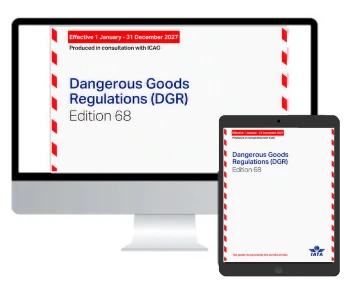
The 68th Edition is available to pre-order now in three formats.
→ Pre-order the IATA DGR 68th Edition 2027 (Regular Bound)
→ Pre-order the IATA DGR 68th Edition 2027 (Spiral Bound)
→ Pre-order the IATA DGR 68th Edition 2027 (Digital Edition)
Important: Regulations change frequently. Always verify requirements against the current official edition of the relevant publication. This article is intended as a general guide only and does not constitute legal or compliance advice.
Frequently Asked Questions
Can you take a power bank on a plane in 2026?
Yes, in carry-on baggage only, up to two per person. Power banks must never go in checked baggage and must be individually protected against short circuit when not in use.
Can you charge a power bank on a plane?
No. Recharging a power bank on board is prohibited under the ICAO addendum that took effect on 27 March 2026. Using a power bank to charge a device is a separate matter and is worded as a recommendation against, not a prohibition. Airlines can and do set stricter conditions, so check your carrier’s conditions of carriage before you fly.
How many power banks can I carry?
Two per person. Unlike the limits on portable electronic devices and spare batteries, the operator cannot approve more.
What is the difference between a power bank and a spare battery?
A power bank is a universal external power source that charges multiple devices, usually by cable. A spare battery is designed to be inserted into or affixed to a specific device. Since the March 2026 addendum they are treated as separate categories with different rules.
When do these rules go into the IATA DGR?
The 68th Edition, effective 1 January 2027. Until then the addendum and IATA’s guidance document operate alongside the 67th Edition, and that guidance is not effective beyond 31 December 2026.
Where can I buy the IATA DGR 68th Edition 2027 in Australia?
The IATA DGR 68th Edition 2027 is available to pre-order from Dandy Booksellers Australia in regular bound, spiral bound and digital formats, with free shipping to Australia and New Zealand on print titles.
References
[ 1 ] ICAO — New power bank restrictions will safeguard international aviation (27 March 2026) — https://www.icao.int/news/new-power-bank-restrictions-will-safeguard-international-aviation
[ 2 ] ICAO — Doc 9284, Technical Instructions 2025–2026 Edition, Addendum No. 1 (27/3/26) — https://www.icao.int/sites/default/files/publications/DocSeries/9284_2025_2026_add_01_en.pdf
[ 3 ] IATA — Changes Regarding Power Banks: Guidance Document for Operators (31 March 2026) — https://www.iata.org/contentassets/90f8038b0eea42069554b2f4530f49ea/guidance-to-operators---power-banks.pdf
[ 4 ] ICAO — Information related to Addendum No. 1 to the 2025–2026 Edition of the Technical Instructions — https://www.icao.int/sites/default/files/DangerousGoods/Guidance Material/1-Information-related-to-Addendum-No-1-to-the-2025-2026-Edition-of-the-Technical-Instructions.pdf
[ 5 ] IATA — Passengers travelling with lithium batteries — https://www.iata.org/contentassets/6fea26dd84d24b26a7a1fd5788561d6e/passengers_travelling_with_lithium_batteries.pdf
[ 6 ] IATA — Dangerous Goods Regulations (DGR) — https://www.iata.org/en/programs/cargo/dgr/

Free Delivery

Free delivery to all Australian and New Zealand mailing addresses.
Discounted E-books
For faster turnaround.
Download link via email within a couple of hours.
Information
 Home
HomeNew Products

Email us at sales@dandybooksellers.com.au
Australia
Dandy Booksellers
58 Allambi Avenue
Broadbeach Waters
4218 Queensland
United Kingdom
Dandy Booksellers Ltd
15 Hoopers Yard
Kimberley Road
London NW6 7EJ
Company registration number: 4846829



All prices in Australian Dollars (AUD)
