




IATA Battery Shipping Regulations 14th Edition 2027, What's New and Who Needs It
What is the IATA Battery Shipping Regulations 14th Edition? The IATA Battery Shipping Regulations (BSR) 14th Edition 2027 is the IATA manual for shipping lithium and sodium ion batteries by air. It gathers every battery requirement from the IATA Dangerous Goods Regulations into one book and lines up with the 68th Edition of the DGR, which takes effect on 1 January 2027.
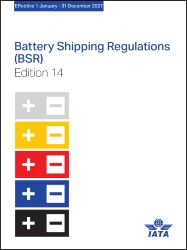
IATA Battery Shipping Regulations 14th Edition 2027 — available from Dandy Booksellers Australia
If your business ships batteries, or products with batteries inside them, the rules move every year. The 2027 edition brings new provisions for hybrid batteries, a long list of packing instruction changes and a new rule on where the battery mark goes. Here's what changed, what carries over from 2026 and who should have a copy on the desk.
What the IATA Battery Shipping Regulations Cover
The BSR is written for manufacturers, retailers, wholesalers, freight forwarders and everyone else in the supply chain who ships batteries by air.[ 1 ] It takes the battery content of the IATA Dangerous Goods Regulations and sets it out in one place, from classification and packing through marking, labelling, documentation and emergency response.[ 1 ]
The manual has widened over time. It was previously published as the Lithium Battery Shipping Regulations. From the 2025 edition it brought lithium, nickel metal hydride and other dry cell batteries into one manual, and added the UN numbers, proper shipping names and packing instructions for sodium ion batteries.[ 3 ]
Our guide to shipping lithium batteries by air and sea covers the wider rules. This post focuses on the 2027 changes.
What's New in the 14th Edition
The 14th Edition reflects the battery changes made in the 68th Edition of the IATA DGR.[ 1 ][ 2 ] These are the ones that matter most to shippers.
Hybrid lithium ion and sodium ion batteries
New provisions cover batteries built from both lithium ion and sodium ion cells. The DGR adds a classification rule for these hybrid batteries and a new special provision, A235, to go with it.[ 2 ]
Revised packing instructions
There are extensive changes to the packing instructions, mainly for sodium ion batteries and prototype batteries.[ 1 ] The 68th Edition amends packing instructions 965 through 970 along with 975 and 978, among many others.[ 2 ] If you have standard operating procedures built on the old wording, check them against the new edition.
Button cells and the four cell, two battery limit
For Section II packages under packing instructions 967, 970 and 978 that contain no more than four cells or two batteries, button cells installed in the equipment no longer count towards that limit.[ 2 ] That's a welcome clarification for anyone shipping devices with a small backup cell on the circuit board.
Battery mark changes
The older battery mark with space for a telephone number is being phased out. IATA says the old mark should not be the only reason for rejecting a package, and encourages shippers to use the current version.[ 2 ] Where a package needs the battery mark and other hazard labels besides the Class 9 battery label, the battery mark now goes on the same surface as those labels.[ 1 ][ 2 ]
New UN numbers
Two new entries join the list of dangerous goods. UN 3563 covers lithium metal batteries installed in a cargo transport unit, and UN 3564 covers sodium ion batteries installed in a cargo transport unit.[ 2 ]
Power Banks and Passengers in 2027
The 68th Edition also changes what passengers and crew can carry, and it settles some of the confusion around power banks in 2026.[ 2 ]
- Passengers and crew can carry no more than two power banks
- Power banks containing lithium ion batteries above 100 Wh are forbidden
- The limit on spare batteries drops from 20 to 18. Airlines can approve more than 18 spare batteries, but never more than two power banks
- Lithium ion battery powered mobility aids above 300 Wh per device face extra operator requirements
IATA's interim guidance to airlines on power banks runs only until 31 December 2026. From 1 January 2027 the 68th Edition takes over.[ 4 ] Airlines can still set stricter rules of their own, so travellers should check with their carrier.
What Carries Over From 2026
The state of charge rules that started on 1 January 2026 continue into 2027.[ 5 ] They're easy to get wrong, so here they are in full.
- Lithium ion batteries shipped by themselves (UN 3480, packing instruction 965) must be at no more than 30% state of charge, and can't go on passenger aircraft without approval
- Lithium ion batteries packed with equipment (packing instruction 966) must be at no more than 30% under Section I. Under Section II, the limit applies to cells and batteries above 2.7 Wh
- Lithium ion batteries contained in equipment (packing instruction 967) are strongly recommended to ship at no more than 30%, or an indicated capacity of 25%, but this is not mandatory
- Vehicles powered by batteries above 100 Wh must ship at no more than 30%, or an indicated capacity of 25%
- Sodium ion batteries packed with or contained in equipment have no set limit, but IATA recommends 30%
Shipping above these limits where they're mandatory needs approval from the State of Origin and the State of the Operator.[ 5 ]
Who Needs the 2027 Battery Shipping Regulations
- Manufacturers and importers of electronics, power tools and battery powered products
- Ecommerce retailers sending products with batteries by air
- Freight forwarders and their dangerous goods acceptance staff
- Ground handlers and airline cargo teams
- Dangerous goods trainers running battery shipping courses
Australian and New Zealand shippers should also note the State variations. The 68th Edition records significant changes or new variations for 17 States, including Norfolk Island and New Caledonia.[ 2 ]
Battery Shipping Regulations or the full DGR?
If batteries are the only dangerous goods you ship, the BSR is the simpler and cheaper book. If you ship any other class of dangerous goods, or your staff accept all kinds of consignments, you need the full IATA DGR 68th Edition 2027. Our IATA DGR 67th Edition guide explains what the DGR covers, and our print or digital guide helps you pick a format.
Print or Digital
The 14th Edition comes as a printed book or a digital edition. Print suits a shared reference at the acceptance counter or in the warehouse, and ships free to any Australian or New Zealand address. Digital suits people who search the text often or work across sites. Ordering for a team? Contact us for bulk pricing.
→ Buy the IATA Battery Shipping Regulations 14th Edition 2027 (Print)
→ Buy the IATA Battery Shipping Regulations 14th Edition 2027 (Digital)
Important: Regulations change frequently. Always verify requirements against the current official edition of the relevant publication. This article is intended as a general guide only and does not constitute legal or compliance advice.
Frequently Asked Questions
When does the 14th Edition of the Battery Shipping Regulations take effect?
The 14th Edition reflects the requirements that apply from 1 January 2027, when the 68th Edition of the IATA DGR takes effect. Shipments from that date should be prepared to the 2027 rules.
Does the BSR replace the IATA DGR?
No. The BSR sets out the battery requirements of the DGR in one book. If you ship any other dangerous goods, you still need the full DGR.
Does the BSR cover sodium ion batteries?
Yes. The manual covers lithium and sodium ion batteries, and the 2027 edition adds provisions for hybrid batteries that contain both.
Can I still use the old battery mark with a phone number?
It is being phased out. IATA says the old mark should not be the only reason a package is rejected, but shippers are encouraged to switch to the current mark.
How many power banks can passengers carry from 2027?
Two at most. Power banks with lithium ion batteries above 100 Wh are forbidden for passengers and crew, and airlines may set stricter limits.
Where can I buy the IATA Battery Shipping Regulations 2027?
The IATA Battery Shipping Regulations 14th Edition 2027 is available in print, and as a digital edition, from Dandy Booksellers Australia with free shipping to Australia and New Zealand on print titles.
References
[ 1 ] IATA, Battery Shipping Regulations (BSR) — https://www.iata.org/en/publications/manuals/battery-shipping-regulations/
[ 2 ] IATA, Significant Changes and Amendments in the 68th Edition (2027) of the Dangerous Goods Regulations — https://www.iata.org/contentassets/852fbcbda9c540b893adee66e9ad81ad/dgr-68-en-significant-changes.pdf
[ 3 ] IATA Knowledge Hub, Dangerous Goods Manuals Updates — https://www.iata.org/en/publications/newsletters/iata-knowledge-hub/dangerous-goods-manuals-updates/
[ 4 ] IATA, Guidance to Operators, Changes Regarding Power Banks (31 March 2026) — https://www.iata.org/contentassets/90f8038b0eea42069554b2f4530f49ea/guidance-to-operators---power-banks.pdf
[ 5 ] IATA, Guidance Document for Lithium Batteries and Sodium Ion Batteries 2026 — https://www.iata.org/contentassets/05e6d8742b0047259bf3a700bc9d42b9/lithium-battery-guidance-document.pdf
Related products

Free Delivery

Free delivery to all Australian and New Zealand mailing addresses.
Discounted E-books
For faster turnaround.
Download link via email within a couple of hours.
Information
 Home
New Products

Email us at sales@dandybooksellers.com.au
Australia
Dandy Booksellers
58 Allambi Avenue
Broadbeach Waters
4218 Queensland
United Kingdom
Dandy Booksellers Ltd
15 Hoopers Yard
Kimberley Road
London NW6 7EJ
Company registration number: 4846829



All prices in Australian Dollars (AUD)
