




IATA DGR 68th Edition 2027: What's Changing and Why You Should Pre-Order Now
What is the IATA DGR 68th Edition 2027? The IATA Dangerous Goods Regulations 68th Edition is the next annual update to the industry standard for shipping hazardous materials by air. It takes effect on 1 January 2027, replaces the 67th Edition, and formally carries in the new power bank and sodium-ion battery rules confirmed earlier in 2026.
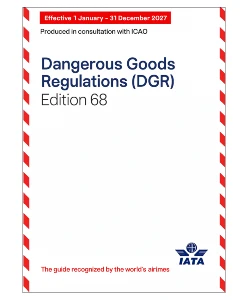
68th Edition 2027 — print
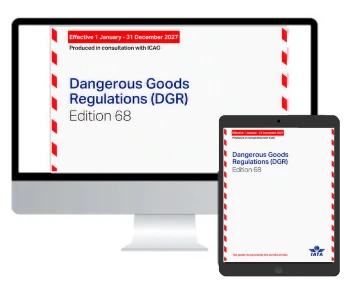
68th Edition 2027 — digital
Freight forwarders and airlines don’t get long between DGR editions. The 67th Edition only took effect on 1 January 2026, and the 68th Edition is already listed for publication, effective from 1 January 2027. Compliance teams treat the DGR as their single reference for classifying, packing, marking and documenting dangerous goods by air, so it pays to know what’s coming and to get your copy ordered before the current edition runs out.
What is the IATA DGR 68th Edition 2027?
The IATA Dangerous Goods Regulations is the operational standard airlines and freight forwarders use worldwide to classify, pack, mark, label and document dangerous goods carried by air.[ 1 ] It is published annually by IATA and is consistent with the ICAO Technical Instructions for the Safe Transport of Dangerous Goods by Air, which carry the legal force through national law.[ 2 ]
The 68th Edition takes over from the current 67th Edition. It reflects changes adopted into the 2027–2028 edition of the ICAO Technical Instructions (Doc 9284), including updates carried through from the 24th revised edition of the UN Recommendations on the Transport of Dangerous Goods, Model Regulations, along with air-specific changes agreed by the ICAO Dangerous Goods Panel.
See also: IATA DGR 67th Edition 2026: What It Is, What Changed, and Who Needs It
Effective dates: when you need to switch
- 67th Edition: in effect 1 January 2026 to 31 December 2026.
- 68th Edition: in effect 1 January 2027 to 31 December 2027.
Mark the changeover date on your compliance calendar now. Training, documentation templates and internal checklists all need to reference the edition that is current on the day a shipment moves, not the edition sitting on the shelf. There is no grace period once an edition changes over, so the safest approach is to have your new copy in hand and staff briefed well before 1 January.
What’s changing in the 68th Edition
Two changes are confirmed directly by IATA and are covered in detail below: the new power bank rules and the formal recognition of sodium-ion batteries.
There is also a useful shortcut for anyone who already owns the current edition. Appendix H of the 67th Edition sets out the proposed revisions taking effect on 1 January 2027, so you can read the direction of travel before the new book lands. Among the items listed there are an extension of the data recorder exceptions to cover sodium-ion batteries, and a clarified classification method for hybrid batteries built from both lithium-ion and sodium-ion cells.[ 3 ]
IATA publishes its official Significant Changes summary for each edition closer to the effective date, as it did for the 67th.[ 4 ] Beyond the confirmed items, expect further updates across:
- Classification and UN numbers, with new and revised entries added or amended
- Packing instructions, particularly around battery consignments
- Special provisions and state variations, reflecting individual country requirements
- Marking and labelling requirements for dangerous goods marks and hazard labels
Because these are not yet finalised, treat them as a guide to the areas likely to move rather than a confirmed list of changes. We will update this article once IATA publishes the official Significant Changes document for the 68th Edition.
Power banks: the biggest confirmed change
Unlike most of what is still to come, this change is locked in. On 27 March 2026, ICAO issued Addendum No. 1 to the 2025–2026 Technical Instructions, splitting power banks out from ordinary spare batteries and tightening the rules around them. IATA has confirmed the 68th Edition will carry these changes into the main regulatory text from 1 January 2027.[ 5 ]
For passengers and crew carrying power banks for personal use, the confirmed position from 1 January 2027 is:
- Power banks are capped at 100 Wh. The allowance for spare lithium-ion batteries above 100 Wh but not above 160 Wh with operator approval does not carry over to power banks.
- No more than two power banks per person, and carry-on baggage only.
- Power banks must not be recharged in flight. This is a mandatory requirement.
- Power banks should not be used to recharge another device in flight. This is a recommendation rather than an outright ban, though individual airlines may impose stricter policies.
- Power banks must still be individually protected against short circuits when not in use, for example by keeping them in original retail packaging or taping over exposed terminals.
One point worth being precise about, because the two positions differ depending on which date you are asking about. Under the addendum as it currently operates alongside the 67th Edition, the 100 to 160 Wh band is contested: the addendum text permits it with operator approval, while IATA’s own passenger table marks power banks in that band forbidden. From 1 January 2027 that ambiguity disappears, because the provision does not carry into the 68th Edition at all. Our guide to the 2026 power bank rules covers what applies between now and then, including the requirements for crew using operator-provided power banks on duty.
Spare lithium-ion batteries that are not power banks are unaffected by the 100 Wh cap and can still be carried up to 160 Wh with operator approval, the same as under the 67th Edition.
See also: Shipping Lithium Batteries by Air and Sea: What the Regulations Actually Require
Sodium-ion batteries get formal recognition
The 68th Edition also carries forward a change already introduced by addendum to the 67th Edition: formal UN numbers for sodium-ion batteries.[ 6 ]
- UN 3551 — sodium-ion batteries with organic electrolyte, shipped on their own.
- UN 3552 — sodium-ion batteries packed with, or contained in, equipment.
The pattern mirrors the lithium-ion split between UN 3480 and UN 3481, so the logic will already be familiar to anyone handling battery consignments. As sodium-ion technology becomes more common in consumer and industrial devices, expect these two entries to start appearing more often on battery marks and shipping paperwork.
Which format should you choose? Digital, regular or spiral bound
The 68th Edition is available in the same three formats as previous editions.
Digital (eBook)
Delivered through IATA’s secure e-reader platform and searchable by UN number or packing instruction. Instant delivery after purchase makes it a practical option for teams who need the DGR on a laptop or tablet, or who want to cut down on printed copies across a large team.
Regular bound (print)
The standard reference copy, well suited to a compliance desk or corporate reference library that needs a sturdy, long-lasting copy of the current year’s framework.
Spiral bound (print)
Lies flat when open, which makes it faster to flip between packing instructions, tables and UN number listings. A popular choice for operational teams working the floor rather than a desk.
See also: IATA DGR: Print or Digital?
→ Pre-order the IATA DGR 68th Edition 2027 (Regular Bound) from Dandy Booksellers
→ Pre-order the IATA DGR 68th Edition 2027 (Spiral Bound) from Dandy Booksellers
→ Pre-order the IATA DGR 68th Edition 2027 (Digital Edition) from Dandy Booksellers
Why order now: pre-order and training considerations
The 68th Edition is currently available to pre-order, with the print editions listed for publication in August 2026 and the digital edition following, well ahead of the 1 January 2027 effective date. Ordering early has three practical benefits.
It gives your team time to review the changes, including the power bank rules above, before they become mandatory, rather than scrambling in the final weeks of December. If your organisation runs internal DG training, certification is tied to the edition in use at the time of the course, so trainers need their copies well before any session that runs into 2027. And pre-ordering secures your copy ahead of the January rush, when order volumes across the industry are at their highest.
How Australian operators stay compliant
CASA requires compliance with the ICAO Technical Instructions for the air transport of dangerous goods in Australia,[ 7 ] and in practice the IATA DGR is the working reference most Australian freight forwarders, ground handlers and airlines use to meet that obligation. Replacing your copy at the start of each edition cycle, rather than partway through, is the simplest way to keep your team and your paperwork aligned with current requirements.
If your business also ships dangerous goods by sea, make sure your IMDG Code copy is current too. The two regimes update on different cycles and are not interchangeable.
See also: Dangerous Goods Compliance in Australia: Road, Air and Sea Requirements
Important: Regulations change frequently. Always verify requirements against the current official edition of the relevant publication. This article is intended as a general guide only and does not constitute legal or compliance advice.
Frequently Asked Questions
What is the IATA DGR 68th Edition 2027?
It is the next annual update to the IATA Dangerous Goods Regulations, the industry standard for shipping hazardous materials by air. It takes effect on 1 January 2027 and replaces the 67th Edition.
When does the IATA DGR 68th Edition take effect?
1 January 2027. It remains the current edition through 31 December 2027, when the 69th Edition is expected to take over.
What is changing with power banks in the IATA DGR 68th Edition?
Power banks are capped at 100 Wh with no operator-approval exception, limited to two per person in carry-on baggage only, and must not be recharged in flight. These changes were confirmed by IATA in 2026 and carry into the 68th Edition from 1 January 2027.
What happens to the 67th Edition when the 68th Edition is released?
The 67th Edition remains the correct working reference until 31 December 2026. From 1 January 2027, the 68th Edition becomes the current edition and the 67th Edition should be retired from active use.
What formats does the IATA DGR 68th Edition 2027 come in?
Digital (eBook), Regular Bound (print) and Spiral Bound (print).
Do I need to retrain staff when a new DGR edition is released?
Certification for IATA-accredited dangerous goods training is tied to the edition current at the time of the course. Staff whose certification spans the changeover should confirm with their training provider whether refresher training is required for the 68th Edition.
Where can I buy the IATA DGR 68th Edition 2027 in Australia?
The IATA DGR 68th Edition 2027 is available to pre-order from Dandy Booksellers Australia in regular bound, spiral bound and digital formats, with free shipping to Australia and New Zealand on print titles.
References
[ 1 ] IATA — Dangerous Goods Regulations (DGR) — https://www.iata.org/en/programs/cargo/dgr/
[ 2 ] ICAO — Technical Instructions for the Safe Transport of Dangerous Goods by Air — https://www.icao.int/safety/dangerousgoods/Pages/technical-instructions.aspx
[ 3 ] IATA — Dangerous Goods Regulations 67th Edition Addendum (1 January 2026) — https://www.iata.org/contentassets/90f8038b0eea42069554b2f4530f49ea/dgr-67-addendum-1---en---01-january-2026.pdf
[ 4 ] IATA — Significant Changes and Amendments in the 67th Edition (2026) — https://www.iata.org/contentassets/90f8038b0eea42069554b2f4530f49ea/dgr-67-en-significant-changes.pdf
[ 5 ] IATA — Changes Regarding Power Banks: Guidance Document for Operators (31 March 2026) — https://www.iata.org/contentassets/90f8038b0eea42069554b2f4530f49ea/guidance-to-operators---power-banks.pdf
[ 6 ] UNECE — UN Model Regulations Rev. 24 (2025), sodium-ion battery provisions — https://unece.org/transport/dangerous-goods/un-model-regulations-rev-24
[ 7 ] CASA — Dangerous goods — https://www.casa.gov.au/dangerous-goods


Free Delivery

Free delivery to all Australian and New Zealand mailing addresses.
Discounted E-books
For faster turnaround.
Download link via email within a couple of hours.
Information
 Home
HomeNew Products

Email us at sales@dandybooksellers.com.au
Australia
Dandy Booksellers
58 Allambi Avenue
Broadbeach Waters
4218 Queensland
United Kingdom
Dandy Booksellers Ltd
15 Hoopers Yard
Kimberley Road
London NW6 7EJ
Company registration number: 4846829



All prices in Australian Dollars (AUD)
