




IMDG Code 2026 Edition (Amendment 43-26): What It Is, Who Needs It and What It Covers
What is the IMDG Code 2026 Edition? The IMDG Code 2026 Edition is the latest consolidated text of the International Maritime Dangerous Goods Code, incorporating Amendment 43-26. It sets the rules for classifying, packing, marking, documenting, stowing and segregating dangerous goods carried by sea in packaged form. SOLAS chapter VII makes compliance mandatory.
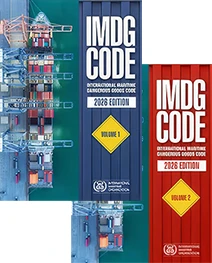
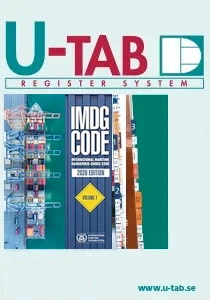
IMDG Code 2026 Edition (inc Amdt 43-26) — available from Dandy Booksellers Australia
A new IMDG Code edition is published every two years, and each one introduces changes that affect day-to-day operations. Amendment 43-26 strengthens requirements for vehicles, addresses lithium and sodium-ion batteries, and updates segregation rules for radioactive material. If your organisation packs, books, loads or trains people to handle dangerous goods by sea, this is the edition your team will work from.
What is the IMDG Code 2026 Edition?
The International Maritime Dangerous Goods (IMDG) Code is the IMO rulebook for the carriage of dangerous goods and marine pollutants in packaged form by sea. SOLAS chapter VII makes compliance compulsory, and MARPOL Annex III applies the same Code to harmful substances carried in packages.[ 1 ] First adopted in 1965 as a recommendation, it became mandatory under SOLAS from 1 January 2004.[ 1 ]
The Code is revised every two years to remain aligned with the UN Recommendations on the Transport of Dangerous Goods (the Model Regulations that also underpin the ICAO Technical Instructions and IATA DGR). The 2026 Edition incorporates Amendment 43-26, adopted by the IMO Maritime Safety Committee at its 111th session in May 2026.[ 2 ]
If you are still working from the current edition, see our guide to the IMDG Code 2024 (Amendment 42-24).
What the IMDG Code 2026 covers
The Code is published in two volumes and organised into seven parts.[ 3 ]
Volume 1
Volume 1 contains Parts 1, 2 and 4 to 7: general provisions, definitions and training; classification; packing and tank provisions; consignment procedures (marking, labelling, placarding and documentation); construction and testing of packagings, IBCs, large packagings, portable tanks, MEGCs and road tank vehicles; and transport operations (including stowage and segregation).[ 3 ]
Volume 2
Volume 2 contains Part 3, the Dangerous Goods List with special provisions and exceptions. It also holds Appendix A (generic and N.O.S. proper shipping names), Appendix B (glossary of terms) and the index.[ 3 ] Most day-to-day lookups begin here with a UN number and proper shipping name.
The Supplement is a separate publication
Emergency response material is not contained in the Code itself. The IMDG Code Supplement includes the EmS Guide (fire and spillage response) and the Medical First Aid Guide (MFAG), together with other related texts.[ 3 ] See our IMDG Code Supplement guide for details.
What is new in Amendment 43-26
Vehicles: new SP 980 safety assessment
The most significant change concerns vehicles. New special provision SP 980 requires the consignor to assess the safety condition of each vehicle before offering it for sea transport. A vehicle showing leakage, damage to its electrical equipment or supplemental restraint systems, or signs of exposure to an extreme event must not be offered until corrective action has been taken and its effectiveness verified. Batteries covered by SP 376 must be removed.[ 2 ]
SP 980 is assigned to UN 3166, 3171, 3556, 3557 and 3558. It does not apply to vehicles driven on board under their own power by passengers on ro-ro passenger ships.[ 2 ]
SP 961 and SP 962 have been rewritten so that SP 980 takes precedence. Conditions for battery-powered and hybrid vehicles have been tightened, including a requirement for installed batteries to be electrically insulated. Under SP 962, unpackaged vehicles are not subject to package marking and labelling, but a cargo transport unit carrying vehicles must be placarded whether the vehicles are packaged or not.[ 2 ]
Batteries: new entries and renamed mark
Two new entries have been added to the Dangerous Goods List:
- UN 3563 LITHIUM METAL BATTERIES INSTALLED IN CARGO TRANSPORT UNIT
- UN 3564 SODIUM ION BATTERIES INSTALLED IN CARGO TRANSPORT UNIT
UN 3536 has been renamed for consistency. All three are assigned stowage category D.[ 2 ]
New SP 410 covers hybrid batteries that combine lithium-ion and sodium-ion cells. These are shipped under UN 3480, 3481 or 3536 and tested as lithium-ion batteries, with every cell meeting UN 38.3. A vehicle powered only by hybrid batteries is assigned to UN 3556.[ 2 ]
The former “lithium or sodium ion battery mark” is now simply the “battery mark”.[ 2 ] For the wider picture across modes, see our guide to shipping lithium batteries by air and sea.
Other changes of note
- Segregation distances for Class 7 radioactive material are now expressed in metres.
- Temperature-controlled cargo transport units must carry two temperature-measuring devices that are independently powered.
- Packagings that have passed a stacking test must be loaded in the same orientation as the tested samples.
- New entries and provisions cover chlorophenols (UN 3561 and UN 3562), MRI scanners (SP 411), dimethyl ether (SP 412) and liquid organic hydrogen carriers (SP 413).
- UN 2857 and UN 3358 now also cover heating machines.
- Part 6 includes a new section 6.10.3 on fibre-reinforced plastic service equipment for portable tanks; pressure receptacles are subject to a “pV-product” limit.
- The GHS reference is updated to the 11th revised edition.
- The EmS Guide has been amended to reflect the new amendment.[ 2 ]
A state-of-charge limit for lithium-ion vehicles was discussed but not adopted.[ 2 ]
Who needs the IMDG Code 2026?
Anyone involved in the movement of packaged dangerous goods by sea. That includes shippers and consignors, freight forwarders, packers and container loaders, shipping lines and ship masters, port and terminal operators, chemical manufacturers and distributors, and businesses that import or export vehicles and batteries.
Vehicle exporters and importers should pay particular attention to SP 980, which places the safety assessment obligation on the consignor. Dangerous goods training providers will need to update course material and delegate copies to the new edition.
Training is mandatory. AMSA requires that everyone involved in the transport of packaged dangerous goods by sea receives training in accordance with chapter 1.3 of the IMDG Code and Marine Order 41.[ 4 ]
How the IMDG Code applies in Australia
AMSA gives effect to SOLAS chapter VII and the IMDG Code through Marine Order 41 (Carriage of dangerous goods), made under the Navigation Act 2012.[ 5 ]
Amendment 43-26 may be applied voluntarily from 1 January 2027 and becomes mandatory on 1 January 2028. Until then, the 2024 Edition (Amendment 42-24) remains the edition in force.[ 2 ] Always check current AMSA guidance for the application of Marine Order 41 to your operation. For the broader compliance picture across road, air and sea, see our guide to dangerous goods compliance in Australia.
Print, digital or the pack?
The 2026 Edition is available as a two-volume hardback set or as a digital edition on the IMO e-reader. A digital pack combining the Code with the IMDG Code Supplement 2026 is also available. For a comparison of formats, see our guide to IMDG Code print or digital and how the digital IMDG Code works.
→ Order the IMDG Code 2026 Edition (hardback, 2 volumes) from Dandy Booksellers
→ Order the IMDG Code 2026 Edition (digital) from Dandy Booksellers
→ Order the IMDG Code 2026 and Supplement 2026 digital pack
Important: Regulations change frequently. Always verify requirements against the current official edition of the relevant publication. This article is intended as a general guide only and does not constitute legal or compliance advice.
Frequently Asked Questions
What is IMDG Code Amendment 43-26?
Amendment 43-26 is the set of changes to the IMDG Code adopted by the IMO Maritime Safety Committee at MSC 111 in May 2026.[ 2 ] The main changes concern vehicle safety assessment under SP 980, new battery entries and provisions, and metre-based segregation for radioactive material. The IMDG Code 2026 Edition incorporates these changes.
Does the 2026 Edition replace the 2024 Edition immediately?
No. The 2024 Edition (Amendment 42-24) remains in force until Amendment 43-26 becomes mandatory on 1 January 2028. Voluntary application of Amendment 43-26 is permitted from 1 January 2027.[ 2 ]
Do I need the IMDG Code Supplement as well?
Yes, if you require the emergency response procedures or medical first aid guidance. The EmS Guide and MFAG are contained in the Supplement, not the Code itself. The IMDG Code 2026 and Supplement 2026 digital pack combines both.
Does Amendment 43-26 change how electric vehicles are shipped by sea?
Yes. SP 980 requires the consignor to assess each vehicle’s condition before it is offered for transport. Damaged vehicles cannot be shipped until corrective action is taken and verified. SP 961 and SP 962 have been tightened for battery-powered and hybrid vehicles.[ 2 ]
Where can I buy the IMDG Code 2026 Edition?
The IMDG Code 2026 Edition (hardback) and the IMDG Code 2026 Edition (digital) are available from Dandy Booksellers Australia, with free shipping to Australia and New Zealand on print titles.
References
[ 1 ] International Maritime Organization, The International Maritime Dangerous Goods (IMDG) Code — https://imo.org/en/OurWork/Safety/Pages/DangerousGoods-default.aspx
[ 2 ] International Maritime Organization, Resolution MSC.587(111), adopting Amendment 43-26 to the IMDG Code, Maritime Safety Committee 111th session, May 2026
[ 3 ] International Maritime Organization, IMDG Code publication information — https://wwwcdn.imo.org/localresources/en/publications/Documents/IMDG%20Code/IMDG%20Code,%202018%20Edition/IL200E.pdf
[ 4 ] Australian Maritime Safety Authority, Carriage of ammonium nitrate of class 5.1 and class 9 to and from Australia (training requirements) — https://www.amsa.gov.au/vessels-operators/cargoes-and-dangerous-goods/carriage-ammonium-nitrate-class-51-and-class-9-and
[ 5 ] Australian Maritime Safety Authority, Marine Order 41: Carriage of dangerous goods — https://www.amsa.gov.au/about/regulations-and-standards/marine-order-41-carriage-dangerous-goods
Related products

Free Delivery

Free delivery to all Australian and New Zealand mailing addresses.
Discounted E-books
For faster turnaround.
Download link via email within a couple of hours.
Information
 Home
New Products

Email us at sales@dandybooksellers.com.au
Australia
Dandy Booksellers
58 Allambi Avenue
Broadbeach Waters
4218 Queensland
United Kingdom
Dandy Booksellers Ltd
15 Hoopers Yard
Kimberley Road
London NW6 7EJ
Company registration number: 4846829



All prices in Australian Dollars (AUD)
